Year-end has historically been a massive giving season. Some nonprofits see 40%+ of their annual budgets come in from their year-end fundraising efforts during the last 45 days of the year.
But over the past few years, giving behaviors have changed.
Year-end is still an absolutely critical giving season. But what used to drive major year-end results may not have the same effect anymore.
Alyssa Boger of AGP (Allegiance Group + Pursuant) and I hosted a live LinkedIn discussion covering:
You can watch the recording below, or keep reading to see how year-end giving behavior has changed and what you can do this year to give yourself the best shot of growing your year-end fundraising results.
The Latest Year-End Benchmark Data
Looking at the year-end fundraising results for a specific year can be deceptive. There are many factors impacting performance that are out of our control as fundraisers.
For example, which day of the week December 31st falls on can have a huge impact on giving.
So to understand what’s really happening with year-end giving, we took a look at the trends of the past 5 years.
Year-End Fundraising is Trending Down
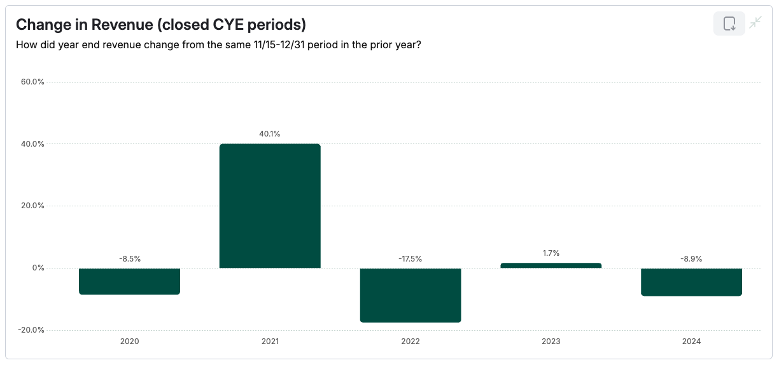
Total year-end giving is on a downward trend.
Although, there have been ups and downs along the way:
- 2020 was down by 8.5%.
- 2021 rebounded and was up by 40%.
- 2022 dropped by 17.5%.
- 2023 was relatively flat—a 1.7% increase.
- 2024 fell by another 8.9%.
All in all, the 5-year revenue trend is down.
To paint the picture with concrete numbers, imagine you raised $1 Million during year-end 2019.
If your results followed the average nonprofit’s, you would have only raised $979k during year-end 2024.
Add inflation into the mix, and the picture gets more bleak.
A nonprofit that raised $1 Million at year-end in 2019 would have needed to raise 26% more at the end of 2024 in order to have the same impact.
But why is year-end revenue on the decline?
Donor Acquisition No Longer Drives Year-End Fundraising Growth
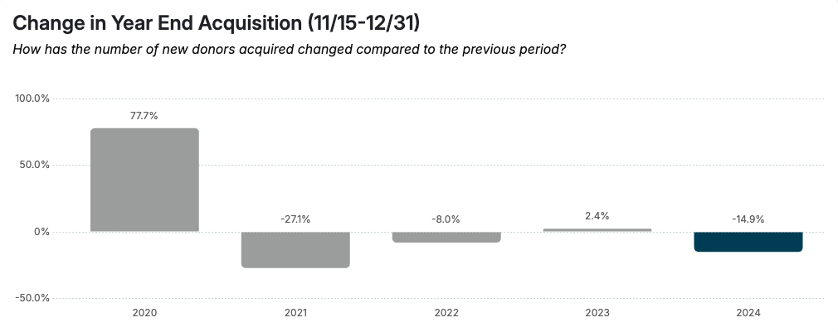
One reason year-end revenue is on the decline is that year-end acquisition is down.
There was a time where year-end was viewed by many to be a significant donor acquisition event. But the trends over the past 5 years suggest it no longer has the same potential for acquisition.
Now, please hear me clearly.
There is still a lot of opportunity for donor acquisition during year-end. It’s just not quite as much as it used to be.
On the flip side, Giving Tuesday continues to be a great opportunity for donor acquisition. Acquisition has been up on Giving Tuesday for 4 of the past 5 years.
So when it comes to year-end acquisition efforts, plan to start them early and make Giving Tuesday a focal point—focusing the last few weeks of the year on activating existing donors.
Retention & Reactivation Declines Are Creating a Problem
There are some larger fundraising trends that may be impacting year-end giving as well.
Donor retention has been steadily declining. In fact, retention is down 9.9% over the past 5 years.
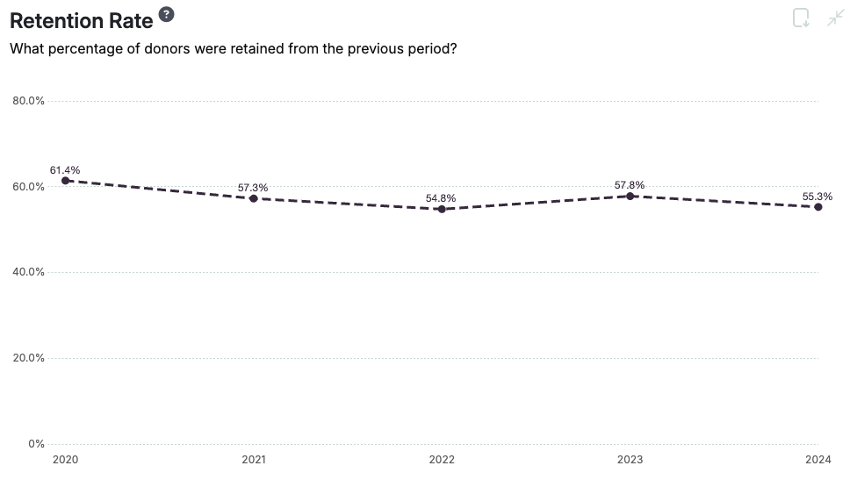
Donor reactivation is seeing the same declining trend. Reactivation rates are down 33% over the past 5 years.
These headwinds make the year-end fundraising season all the more challenging to see growth.
But it’s not all doom and gloom. There are some bright spots to be encouraged about, and some opportunities for growth.
3 Year-End Fundraising Trends to Be Optimistic About
While year-end revenue is on the decline, there are bright spots to be encouraged by. And they represent opportunities for you to see growth this year.
Slower Year-End Fundraising is Not Sinking the Annual Budget
Nonprofit revenue as a whole is also on a slightly downward trend. But it’s not to the same degree as the year-end giving season.
Just because you see a dip in year-end giving doesn’t mean you’ll see an equivalent dip in your overall fundraising revenue.
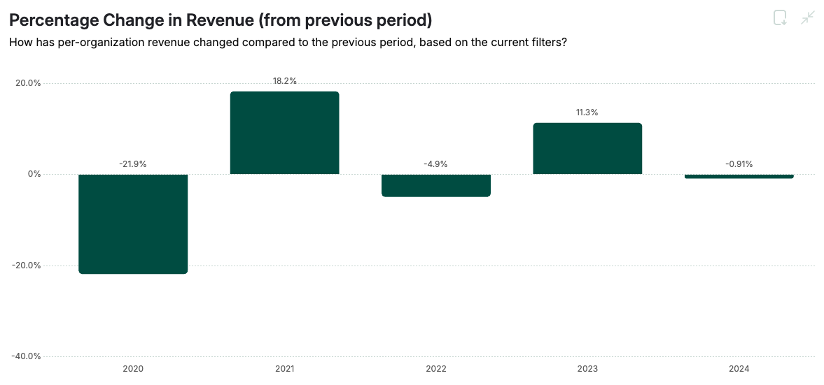
This signals that donor behavior is changing significantly.
Year-end has historically been the lifeblood of many organizations’ budgets. And it’s still mission critical.
But there is increasing opportunity for sustainable giving programs throughout the year that can give your organization greater stability—and not be conditional on a single high-urgency campaign.
Many Nonprofits are Seeing Retention & Reactivation Improvements
The overall trend is that donor retention and reactivation are decreasing.
But many organizations are piloting new initiatives that are bucking the trend.
KCBI, for example, was able to increase recurring donor retention by 19% by implementing an Avid-powered cultivation series. It’s hyper-personal, authentic, and focused on building a stronger relationship with the donor.
Luther Seminary saw increases in retention and donor reactivation by using Avid to power a reactivation campaign using Meta advertising.
These case studies are models to follow as you consider how to improve retention and reactivation in your own fundraising efforts.
Omni-Channel Approaches are Leading to Increased Revenue
Any organization investing in an omni-channel approach to their communications is seeing the returns.
The data is undeniable.
The more channels in which you’re able to reach and communicate with your donors, the higher the donor value and the higher their likelihood of upgrading.
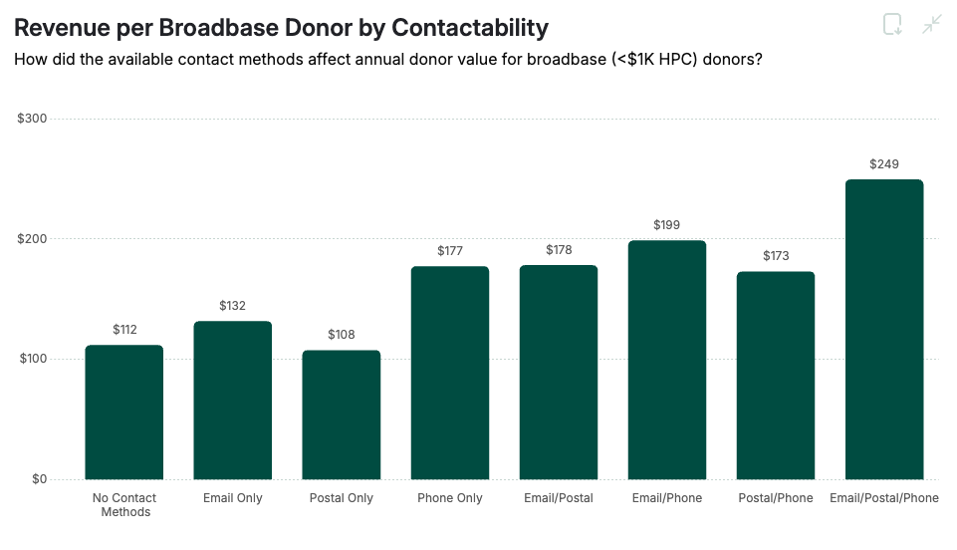
Historically, many fundraisers have isolated donors to the channel of their original gift.
If they gave via the mail, the only get direct mail cultivation.
If they gave online, they’ll only get email cultivation.
Modern fundraising has changed. It requires us to communicate and cultivate donors in all the channels they engage in—even if they only ever give through a specific channel.
4 Tactics to Grow Your Year-End Fundraising
There’s a lot changing when it comes to year-end giving trends.
Many key metrics are trending down and are cause for concern. But lots of nonprofits are still finding new ways to grow.
Here are 4 tactics shared from Alyssa Boger (Allegiance Group + Pursuant) that can help you see fundraising growth this year-end season.
Leverage Low-Cost Channels Like Digital for Donor Acquisition
Even with overall acquisition on the decline during the year-end season, online giving is a bright spot.
Many organizations are seeing online acquisition perform strongly during the year-end season.
The combination of more donors shifting giving online and the comparatively low cost of digital ads make online acquisition a primary tactic leading into the year-end season.
Allegiance Group + Pursuant worked with 3 organizations last year-end season who invested significantly in online donor acquisition:
- Philabuandance saw a 34% increase in revenue with 5% lower spend.
- MSAA increased revenue and ROI with a lower spend.
- Audubon saw a 10% increase in media revenue with a surge of new donors.
These organizations used a blend of paid search, paid social, and programmatic display advertising to drive these results.
Leverage Mid-Level Donors to Fuel Match Campaigns
Alyssa also recommends a key strategy on how to best leverage mid-level donors.
Consider reaching out to mid-level donors prior to your year-end campaign to engage them in a matching campaign.
Ask them to give to a fund that will be used to incentivize other donors throughout year-end to give as well. This type of engagement can help reactivate mid-level donors, lead to upgrades, and ultimately fuel greater giving across your year-end season.
Moody Bible Institute ran a targeted upgrade offer to their mid-level donor that led to a 443% increase in revenue.
These mid-level donors remained in all the additional year-end communications. And many chose to give again later on in the season.
Omni-Channel Direct Response is Your Strongest Play
Year-end season is a notoriously challenging time of year to get your donor’s attention.
Between holiday activities, the biggest retail season of the year, and all the other nonprofits vying for your donor’s gift, omni-channel communication is the primary way to ensure you stay top of mind.
What does omni-channel communication mean?
It means creating a coordinated communication plan that leverages every channel available:
- Direct mail
- Emails
- Paid social ads
- Paid search ads
- Display ads
- Organic social content
- Phone calls & SMS
Some of these channels will emerge as the most effective for driving a conversion (aka a donation). But every channel is critical for staying top of mind.
Your ads make your direct mail appeals more effective. The reminder SMS you send to your donors during the last week of the year makes your final email appeal more effective.
One organization called City of Hope worked with Allegiance Group + Pursuant to create an omni-channel Giving Tuesday campaign.
By intentionally coordinating the communication and investing in a wide variety of channels, they drove a 19% increase in Giving Tuesday revenue including:
- An 11% increase in total gifts
- A 43% increase in donors
- An 8% increase in average gift size
Plan to Turn Year-End Donors into Lifelong Sustainers
After year-end is over, there is a prime window of opportunity to convert donors into a lifelong sustainer.
Plan to reach out to your new donors in January to ask them to become a recurring donor.
But there’s more to making the recurring donation ask then simply giving the donor the option to give monthly. Your value proposition is critical.
NAMI, working with Allegiance Group + Pursuant, rebranded their monthly giving program from “Sustainer Circle” to “Table of Hope.”
On the surface, this seems like a simple change. But the “Table of Hope” language came from the early roots of the organization. It allowed them to open up more meaningful messaging around why someone should become a recurring donor.
By leaning into a stronger value proposition, they saw a 226% increase in new sustainers and a 200% increase in sustainer upgrades.
Powering Year-End Growth with Avid
Growing year-end giving can feel complicated.
Even with practical strategies, how do you get started? How do you make time to pilot a new approach? And how do you know whether or not it’s working?
As the fundraising operating system, Avid simplifies all of this.
- Avid Benchmarks help you visualize how your performance compares to others.
- Avid Insights helps you identify exactly what areas you need to focus on.
- Avid Pathways creates and manages all the segmentation you need to execute.
- Avid Playbooks generates and deploys the all the creative for each audience segment in minutes.
Want to see how Avid can be the fundraising operating system to help you get the most out of your year-end fundraising? Watch an Avid demo instantly »