How Avid-Powered Fundraising Automation Led to a Winning Upgrade & Retention Strategy
Budgets are getting tighter. Resources are limited. Hiring more staff is almost never an option.
But in modern fundraising, donors expect more.
Personal communication.
Timely outreach.
Tailored content.
How is an organization expected to keep up? And is it even worth it to try?
Nathan Hill of Avid and Bryce Johnston of Brad Cecil & Associates teamed up to tackle how fundraising automation leads to major improvements in results.
No more spreadsheets.
No more manual number crunching.
Watch the recording of the live webinar below, or keep reading to see how one nonprofit increased donor retention by 200% using Avid-powered fundraising automation.
The State of Basic Fundraising Segmentation
More than ever before, donors expect to be known by the nonprofits they support.
You should know their name. Their values. Their communication preferences. Their giving history.
But the hard reality is that most nonprofit tech stacks don’t allow for this.
For most fundraisers, segmented and personalized communication is a manual effort.
Let’s say you’re trying to reach out to new donors with an ongoing cultivation series. This type of audience sounds easy to create.
But here’s the process for most fundraisers:
1. Build a list in your CRM.
This sounds easy enough. But most CRMs don’t have a default audience or list for exactly what you need.
Even if there’s a simple option to select new donors, it usually doesn’t have the filters you need.
Larger donors need separate communication.
Recurring donors need customized messaging.
Invalid emails need to be scrubbed.
In most cases, fundraisers hit a wall in their CRM. Which leads us to step 2.
2. Export your audience to a spreadsheet.
After you hit a wall in your CRM, you need to get your hands dirty working in a spreadsheet.
You export your list. Fire up excel. Turn on your filters and get to work.
The problems here are plenty.
First, it’s a slow process. Most of us have to do a Google search to remember the name of a critical formula, create a pivot table, run a VLOOKUP and more.
Second, there are countless ways to make mistakes. Any manual process introduces more chances for error:
- You forget that you had a particular filter on.
- You accidentally shift your rows while moving data around.
- You save the file in the wrong format and lose all your work.
If you make it through the gauntlet of manual spreadsheet work, then it’s time for step 3.
3. Import your list to your fundraising tool.
Once you’ve manually dialed in your list, now you need to get it into your fundraising tool of choice.
You open your email platform. Meta/Facebook ads manager. Your SMS tool.
When you run your import, you have to map your fields—introducing another opportunity to accidentally make a mistake.
While this step is generally straightforward, it takes time. And you don’t have extra time.
The worst part?
None of your performance data is connected back to your CRM.
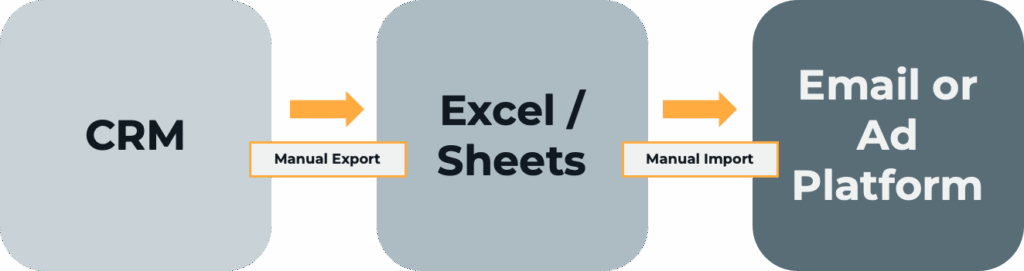
How are you going to know how someone’s engagement within your fundraising channel impacts their long-term value?
You could pay an expensive agency to stitch your data together into a nice Powerpoint slide.
But by then, the data is out of date and isn’t actionable.
4. Repeat this process forever.
The worst part about manual processes is that they never end.
Want to send a new donor welcome series?
Great! You get to export a list of new donors every week forever.
Want to send a giving anniversary message to your donors?
Perfect! Now you’re pulling a manual list every single day.
Want to send a personalized upgrade appeal to donors who give frequently?
Sorry! You don’t have enough time left in your day to pull the audience. And no one else on your team wants to volunteer.
The Data Says We Need Fundraising Automation
Most fundraisers feel this pain.
But the need for fundraising automation goes well beyond increasing our capacity.
There are some concerning trends happening in fundraising that automation can help solve.
Donor Upgrade Rates are at a 5-Year Low
One of the best ways to grow your fundraising revenue is through retaining and upgrading existing donors.
New donors cost a tremendous amount of money to acquire. And their real value to your fundraising program kicks in if they retain and upgrade their giving over time.
However, the upgrade rates of broadbase to mid-level donors is down.
It’s actually been trending down for 5 straight years.
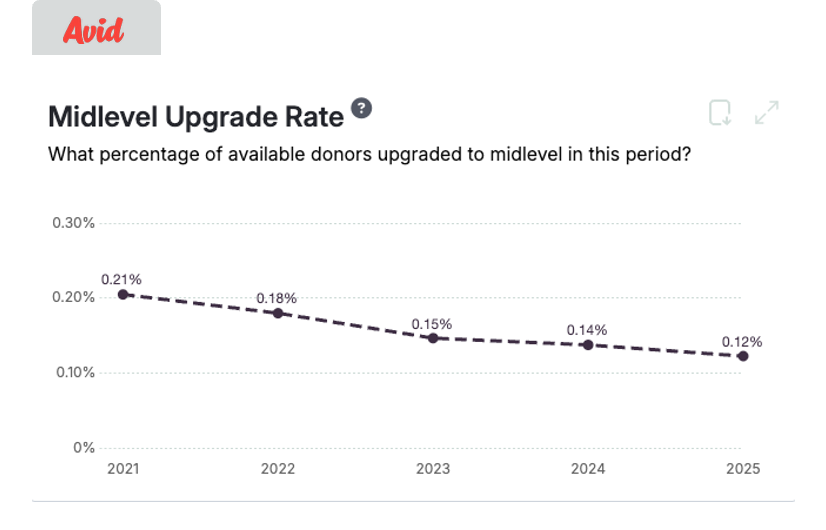
The same story is true for major donors. Upgrade rates for major donors are at a 5-year low.
Total Active Donors are Down
Not only are upgrades down. But the average number of donors giving to a nonprofit is down.
There was a major uptick in 2021 as donors came out in droves during the middle of the pandemic.
Since then, active donors have declined every year.
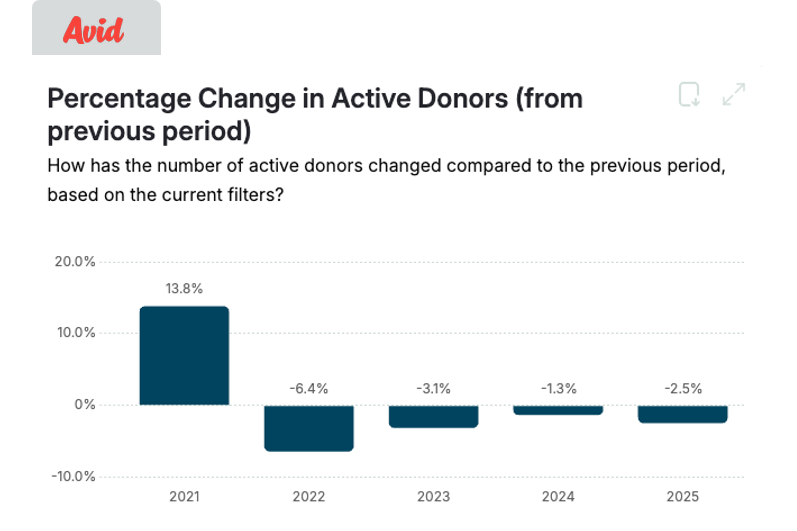
GivingUSA reports similar findings with the percentage of revenue from individual donors shrinking.
Even organizations who are maintaining their revenue are typically doing so because of fewer donors giving larger amounts.
This trend does not bode well for fundraisers trying to ensure long-term organizational health.
Retention and Reactivation Continue to Drop
There’s an ongoing crisis happening around donor retention.
Although there have been a couple of years lately where it’s slightly up, the 5-year trend is down.
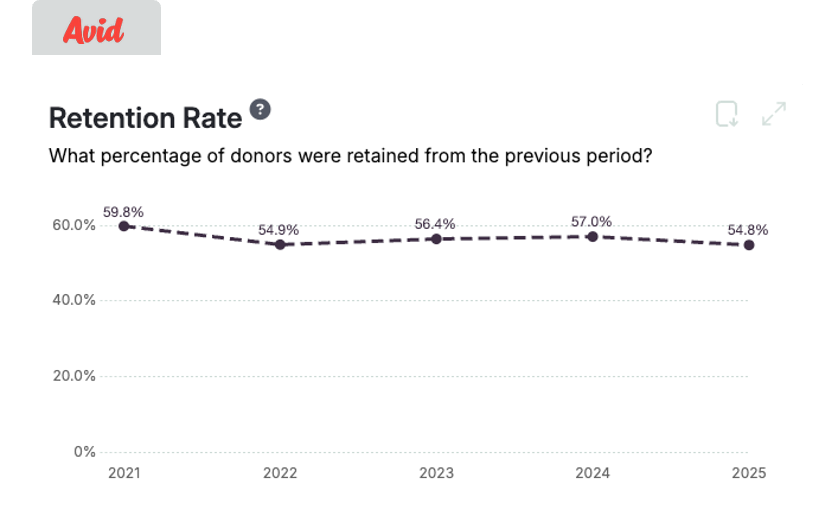
This slow trickle of retention rates backs up the continual decline in active donors. Fewer people are continuing to give to nonprofits over time.
Reactivation rates are dropping every year as well. The combination of declining reactivation and retention puts fundraisers in a challenging situation.

With fewer resources and limited budgets, how do we start to turn these metrics around?
Fundraising Automation Helps Meet Donor Expectations
One reason these metrics may be on the decline is because of donor expectations.
The world around our donors is customized, personalized, and tailored to them.
Their daily news.
Their TV shows.
Their product preferences at Target.
Their commonly ordered groceries.
Everything is tailored and customized. Everything besides their experience with the organizations they donate to.
For fundraisers to create communications that lead to long-term giving, we have to reach our donors in a personal way at scale.
This can be done in 2 ways.
You can hire more staff. Or you can scale with technology.
For most fundraisers, hiring more staff is out of the question. But with AI tools, fundraising automation is at our fingertips—allowing us to scale personalization with technology.
Increasing Retention by 200% with Fundraising Automation
Bryce Johnston and the team at Brad Cecil and Associates identified a problem when working with Tarrant Area Food Bank.
Their retention rates for broadbase donors were below the nonprofit fundraising benchmark.
Fixing retention rates is no easy task.
It usually requires a lot more data analysis to understand the root cause. And the solutions often require in-depth personalization.
Here’s how they diagnosed and solved the problem.
Diagnosing the Donor Retention Problem
Tarrant Area Food Bank’s broadbase donors were retaining around 21%.
Retention rate averages can vary based on the type of nonprofit. According to Bryce, a typical, healthy food bank usually sees a 23% retention rate for their broadbase donors.
Tarrant Area Food Bank was not too far off, but a 2% difference in retention can make a big impact on revenue.
Using Avid Insights, they were able to zoom in.
Avid’s AI-driven fundraising intelligence allowed Tarrant Area Food Bank to see the root cause of their retention issue.

Donors who gave less than $100 were retaining at a dismal 11%.
By implementing a fundraising automation strategy, Bryce and the team at Brad Cecil & Associates helped turn this around into a 33% retention rate.
That’s a 200% increase in donor retention!
Here’s how they did it.
Fixing Retention with Fundraising Automation
With these small dollar donors retaining at such a low rate, they devised a plan.
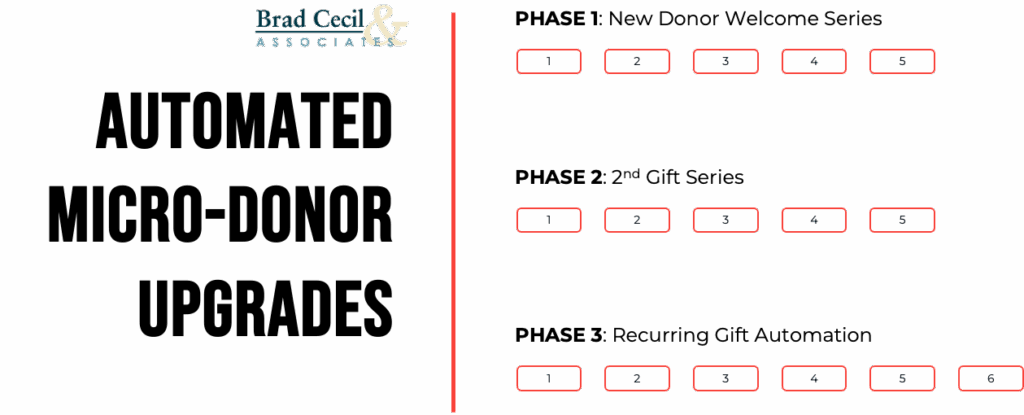
The plan would use a fundraising automation strategy to cultivate these donors, lead them towards a second gift, and ultimately upgrade them to a recurring donor.
Phase 1: Cultivating New Donors
To start, they developed a new donor welcome series.
This series included 3 to 5 automated emails sent over the course of a new donor’s first 30 days.
The purpose of the series was not to secure a 2nd gift, but to welcome the donor:
- Expressing gratitude
- Celebrating their decision to give
- Telling powerful stories of impact
- Showcasing key programs
While the concept of a new donor welcome series doesn’t sound overly complex, execution is nearly impossible without fundraising automation.
Tarrant Area Food Bank used Avid to automatically identify new donors, and trigger this email fundraising series.
No CRM queries. No spreadsheets. No manual exports or imports.
Fundraising Automation Tip:
Tarrant Area Food Bank used Avid to identify brand new donors, syncing them to their email tool to deploy the new donor welcome series.
Phase 2: Winning the Second Gift
In the new donor’s 2nd month, the fundraising automation strategy shifted.
Now that the donor had been welcomed, it was time to invite them to give again.
This automated 2nd gift email fundraising series consisted of 3-5 automated emails over a 7 to 10 day period.
The emails were a mix of content types:
- High value cultivation
- Direct donation appeals
- Messaging reiterating the impact of giving
Fundraising Automation Tip:
Tarrant Area Food Bank used Avid to identify donors who already gave their second gift, automatically removing them from the email series.
Phase 3: Upgrading to a Recurring Donation
After securing the 2nd gift, a steady giving relationship has been established.
The next and final stage of this fundraising automation sequence focused on converting the donors giving into a monthly recurring donation.
It included 4-6 automated fundraising emails sent over 10-14 days.
These emails emphasized:
- The unique benefits or recurring giving
- The greater impact of a monthly donation
- Affirmation of the donor’s values and mission alignment
Fundraising Automation Tip:
Tarrant Area Food Bank used Avid to identify donors who had already upgraded their gift to monthly and removed them from the campaign automatically.
Powering Your Fundraising Automation
The challenge with a fundraising automation strategy is that you need a system to execute it.
For most fundraisers, their tools don’t communicate.
Their email tool is disconnected from their CRM.
Their segmentation is done manually.
To see a 200% increase in retention, you need a fundraising operating system that connects your tools, your data, and your strategies.
All under one roof.
Avid is the fundraising operating system that unifies your tech stack and powers the most robust of fundraising automation strategies.
Avid Pathways can create segmentation based on data from all of your fundraising tools. It updates your audiences every day. And it keeps them in sync with each channel automatically.
Here’s a short video on how Avid Pathways empowers your fundraising automation strategy.
Book a Fundraising Automation Strategy Session
Want to brainstorm ideas on how you can use fundraising automation to grow your revenue?
Schedule a 30-minute strategy session with an Avid expert. During your session, you’ll:
- Review your fundraising tech stack to identify challenges and opportunities
- Brainstorm fundraising automation ideas that can lift results
- Preview how Avid can power your fundraising automation