Every fundraiser wants to grow.
But too often, growth feels like a guessing game—an endless cycle of “test and hope” without a clear sense of what success looks like.
Even true A/B split testing can feel like guess work. And not everyone has enough volume of traffic and donors to make it work.
So how do you take the guess work out of spotting growth opportunities?
That’s where benchmarks come in.
A strong benchmark report isn’t just a yardstick—it’s a flashlight. It helps you spot what’s working, what’s lagging, and where the biggest opportunities lie.
But to use it well, you need to go beyond passive comparison. You need to use benchmarks as a launchpad for smarter campaigns, sharper strategies, and real revenue growth.
Here are seven ways to do just that.
1. Spot Underperforming Channels and Fix Them Fast.
Benchmarks help you see how your performance stacks up to other organizations. And the simplest way to find growth opportunities is by channel.
Keep in mind, when comparing performance, you have to compare apples to apples.
Don’t just look for how much revenue you get from a channel versus the benchmark. You want to look at the percentage of revenue coming from particular channels.
Do you have a low percentage of revenue coming from direct mail?
How about donations from email? Or paid advertising?
Don’t shrug—dig in.
If you see a particularly low spot, it might mean there is an opportunity for growth.
Underperformance isn’t just a red flag. It’s a neon sign pointing to opportunity.
With benchmarks in hand, you can pinpoint which channels need a refresh—then adjust your creative, cadence, or targeting to close the gap.
2. Prioritize The Most Valuable Donor Segments
Not all donor segments are created equal.
Benchmarks can reveal which segments are driving the most value for nonprofits at large—and where you’re leaving money on the table.
You might look at a benchmark and find that the average nonprofit brings in a slightly higher percentage of new donors than you do.
This could certainly be a growth opportunity. But are there more valuable opportunities?
Start with the most valuable segments.
How about reactivated donors? Retained donors? Or even recurring donors?
Reactivating 2% more donors is generally going to be of much greater value to you than acquiring 2% more new donors.
Reactivated donors tend to stick around longer. They tend to give more. And it often costs less to reactivate a donor than it does to acquire a new one.
Build a reactivation journey. Rework your winback messaging. Segment by donor type or recency. When you use benchmarks to surface high-potential gaps, you stop spinning your wheels and start driving ROI.
3. Recalibrate Your Campaign Cadence
Ever wonder if you’re asking too often? Or not enough?
Benchmarks can help answer that.
Not many fundraising benchmarks show you every organization’s messaging cadence. But that doesn’t mean you can’t get ideas of how often to communicate.
Use downstream metrics to answer bigger questions.
One possible sign of needing to recalibrate your messaging cadence is gift frequency.
Some benchmarks, including Avid Benchmarks, will show you how often a donor gives to a nonprofit on average.
If your gift frequency is on the low end, it could mean that you’re not asking enough.
But be careful!
One metric on its own rarely tells the whole story. There are a number of factors that could impact gift frequency:
- More frequent cultivation messaging can drive more traffic to organic giving opportunities.
- More recurring donors means a higher natural volume of transactions.
Always be sure to explore related metrics to make sure you’re getting the full picture.
4. Balance Your Revenue Mix by Channel
Smart fundraising isn’t just about doing more—it’s about balance.
A benchmark report can show you how your revenue streams compare to sector norms. Maybe your peer organizations drive 22% of donations from sustainers—and you’re sitting at 12%.
That’s a clear prompt to strengthen your monthly giving program.
Or maybe you notice that your peers are acquiring more new donors online than offline—while your online donors haven’t grown anywhere near the same rate.
This could signal a need for a strategic shift.
Use benchmarks to see beyond the obvious.
Diversifying your revenue sources creates stability—and resilience. Especially in times of uncertainty.
Benchmarks can help you identify a healthy mix of channels, giving you more levers to pull when facing down fundraising goals.
5. Balance Your Revenue Mix by Giving Level
A healthy fundraising program has a vision for the future.
The best fundraisers don’t just look at this fiscal year’s projections. They look 3 to 5 years down the road.
Understanding your mix of giving levels and their long-term value helps paint a clearer picture of how your fundraising today impacts your long-term picture.
To have a healthy long-term picture, you need a mix of giving levels.
Benchmarks help keep you on course.
Looking at a benchmark, you can easily spot how your mix of giving levels compares.
Do you have a lot fewer broad base donors? What’s the plan when your major donors go away?
Broadbase donors of today fuel your major giving pipeline of tomorrow. And benchmarks can help you keep the right mix.
Do you have a lot of broad base, but few mid-level and major donors?
The purpose of broad base giving is generally to lead to upgraded donations. Benchmarks can help you understand if you need to spend a more focused effort on upgrading donors.
6. Study the Leaders, Not Just the Average
Medians are helpful. But outliers are instructive.
The best benchmark reports don’t just show averages—they highlight top performers. And that’s where things get interesting.
How are these high-growth organizations structuring their teams? What tactics are they using? Where are they investing?
If you look at benchmarks and are content to meet the average, you’ll be stuck in mediocrity forever.
Look at the top performers. Study the best in class.
Don’t just ask “How do we compare?”
Ask, “What are they doing that we’re not?”“What would it take to close that gap?”
That’s how you shift from reactive to strategic.
7. Learn from Other Verticals, Not Just Your Own
Looking at other organizations like yourself is of some value.
It helps you make sure you’re on track. It helps contextualize your results. It ensures your performance isn’t way off from similar programs.
But if you only look at similar organizations, you might not come away with any new ideas.
The best ideas come from outside the box.
Most transformational ideas come from outside the box thinking. Looking at the leaders. Studying the best in class.
You might find that some verticals are outperforming your organization with recurring donors. Or in acquisition. Or in offline growth.
You can throw your hands up and say “we’re just not like them.”
Or you can learn from their strengths. See what concepts you can borrow. Test a proven idea from one vertical within your own organization.
Top Benchmarks to Utilize for Growth
Avid Benchmarks
Avid Benchmarks use live data, providing up-to-date insights that never go stale.
While many benchmarks leverage survey and manual user inputs, Avid pulls directly from the source. This gives both higher quality as well as deeper insights that no other benchmark can provide.
Giving USA
These industry wide benchmarks get released once-per year, and provide a snapshot of the sector at large. How is giving and philanthropy trending? Where is funding coming from? How should we think about the future of fundraising?
Fundraising Effectiveness Project
Fundraising Effectiveness Project is published by AFP, and provides quarterly updates on the state of giving. You’ll find great insights around topics like year-end performance, donor retention trends, and more.
M+R Benchmarks
M+R Benchmarks have become a staple of the sector in recent years. Published annually, they dive into nuanced details like advertising trends, website performance, social media metrics, and more.
NextAfter Digital-First Benchmarks
NextAfter’s digital-first benchmarks are smaller in terms of sample size, but they look specifically at organizations that seeing major digital growth. If you’re aiming to grow your digital fundraising, this benchmark is the place to start.
Growth Isn’t Magic. It’s Measurement and Action.
At Avid, we believe growth doesn’t start with a hunch. It starts with insight.
Benchmarking helps you stop guessing and start improving. It gives context to your data—helping you know where to dig in.
But there’s a common problem. Most benchmark data is out of date by the time it’s published.
How do you know the trends are still true?
What if something has changed?
What if last year’s trends were an anomaly?
Avid Benchmarks are live.
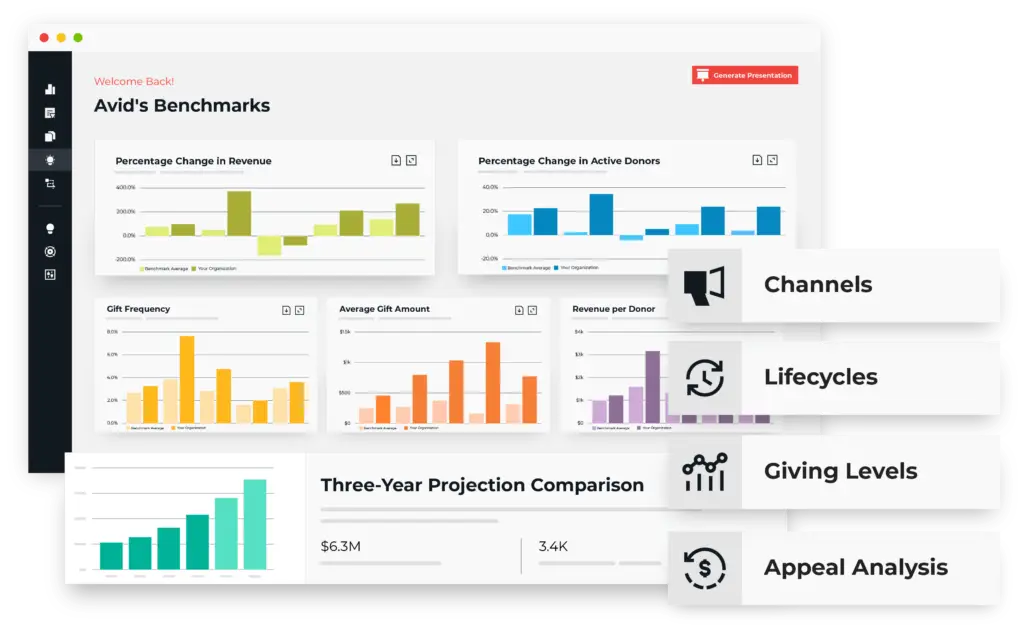
They’re based on data that’s updated every day. They directly compare your most current performance against reliable data from other nonprofits.
And because the data is pulled directly from the source, you can trust the insights.
Want to shine a flashlight on your own growth opportunities using benchmarks?